
What They Are, How They Work, and How to Choose the Right One
When the barrier is functioning well, skin feels more comfortable, less reactive, and more resilient. Skin protectants are one of the tools available to support that process when reinforcement is needed: They are formulated with FDA-approved active ingredients designed to temporarily protect compromised skin and reduce moisture loss.
Skin barrier needs shift based on environment, routine, and skin state. Understanding occlusion, active ingredients, and format allows you to select the appropriate level of support—whether that is a gel, balm, cream, or ointment. Below is a helpful guide to determining the skin protectant that works best for your skin and individual needs.
What Is a Skin Protectant?
Skin protectants and moisturizers are often confused because their textures and benefits can overlap. But they are not the same category of product: The key difference between skin protectants and moisturizers comes down to how they support and protect the skin barrier.
A skin protectant is an over-the-counter (OTC) drug product formulated with an FDA-approved active ingredient that temporarily protects compromised skin and helps relieve minor irritation. The most common OTC skin protectant active ingredients include:
- Petrolatum
- Dimethicone
- Colloidal Oatmeal
- Glycerin (at specific concentrations)
- Allantoin
- Calamine
- Lanolin
- Zinc Oxide
As OTC drug products, skin protectants are permitted to make temporary protective claims like helping protect dry, cracked, chafed, or irritated skin.
Why Skin Barrier Protection Matters
The skin barrier is the outermost layer of skin and plays a central role in preventing transepidermal water loss, limiting the penetration of irritants, and maintaining overall skin resilience.
Skin barrier disruption is common in eczema-, rosacea-, and psoriasis-prone skin. When the barrier is compromised, skin may feel tight, flaky, itchy, or reactive. It may sting more easily; it may appear rough or uneven.
Skin protectants are designed to support the barrier during these moments by forming a temporary protective layer that reduces moisture loss and helps shield skin from environmental stressors.
How Do Skin Protectants Differ from Moisturizers?
It is common to assume that thicker formulas are skin protectants and lighter formulas are moisturizers. However, texture alone does not determine whether a product is classified as a skin protectant or a moisturizer.
A skin protectant is regulated as an OTC drug product. It contains an FDA-approved active ingredient and is permitted to make temporary protective claims, such as helping protect dry, cracked, or irritated skin.
A moisturizer is regulated as a cosmetic product. It focuses on hydration and barrier maintenance, supporting long-term skin comfort and resilience without carrying OTC drug classification.
Both can support the barrier. Only skin protectants are classified for temporary protective function. Understanding this distinction helps determine when a skin protectant is appropriate.
Are All Skin Protectants Occlusive?
Occlusion refers to how effectively a product reduces transepidermal water loss by forming a protective layer on the skin. Higher occlusion means stronger moisture retention and greater environmental shielding. A skin protectant can be occlusive, but not all skin protectants are.
When Skin Needs More Protection
Skin barrier needs can change based on climate, routine, and skin condition.
You may benefit from higher occlusion when:
- Skin feels cracked or visibly compromised
- Weather shifts to cold, dry, or windy conditions
- You are experiencing a flare
- Skin is recovering from irritation
- You want additional overnight support
In humid environments, lighter occlusion may be sufficient. In colder or drier climates, stronger occlusion can help reduce moisture loss more effectively.
During the day, many people prefer breathable protection. At night, higher occlusion can support barrier recovery.
Adjusting occlusion based on skin needs helps prevent overuse or insufficient protection.
How Barrier Disruption Shows Up
Barrier disruption can present differently depending on skin type and condition.
Common signs include:
- Persistent dryness
- Increased reactivity
- Rough or uneven texture
- Redness associated with compromised skin
- Stinging with otherwise well-tolerated products
While skin protectants do not treat or repair underlying medical conditions, they temporarily protect compromised skin and help reduce additional moisture loss while the barrier stabilizes.
For individuals with sensitive or reactive skin, third-party recognitions — such as those from the National Eczema Association, National Rosacea Society, or National Psoriasis Foundation — may provide additional reassurance when selecting products.
How to Choose the Right Skin Protectants
Choosing the right skin protectant depends on your skin state, environment, and comfort preference. Occlusion depends on the active ingredient, its concentration, and the overall formulation.
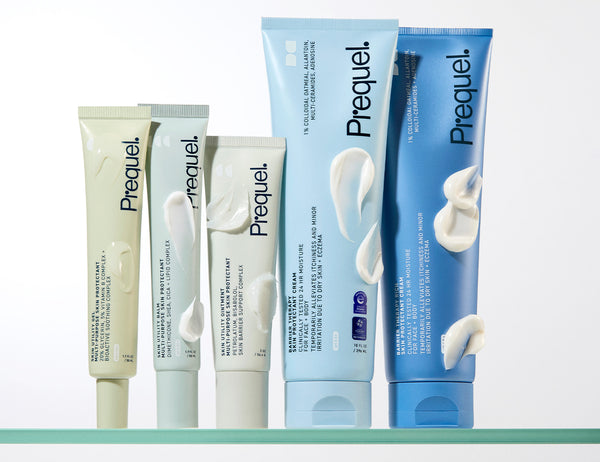
All Prequel skin protectants are formulated to protect the skin without ever feeling greasy or heavy. Their textures and purpose vary—we like to keep more than one on hand for different skin needs.
The Prequel Skin Protectant Collection:
When the barrier is functioning well, skin feels more comfortable, less reactive, and more resilient. Skin protectants are one of the tools available to support that process when reinforcement is needed: They are formulated with FDA-approved active ingredients designed to temporarily protect compromised skin and reduce moisture loss.
Skin Utility Gel
OTC Active: 20% Glycerin
Skin Utility Gel is a lightweight, lower occlusion protectant that supports hydration while reinforcing the barrier. Appropriate when skin needs protection and hydration without heaviness. Skin Utility Gel has received the National Eczema Association (NEA) Seal of Acceptance, National Psoriasis Foundation (NPF) Seal of Recognition, and National Rosacea Society (NRS) Seal of Acceptance.
Skin Utility Balm
OTC Active: 5.25% Dimethicone
Skin Utility Balm forms a flexible, breathable protective film with moderate occlusion. Suitable when skin needs reinforcement and you prefer a mid-weight finish. Skin Utility Balm has received the National Eczema Association (NEA) Seal of Acceptance and National Psoriasis Foundation (NPF) Seal of Recognition.
Skin Utility Ointment
OTC Active: 45% Petrolatum
Skin Utility Ointment provides high occlusion. Best for severely dry, cracked, or compromised areas requiring maximum shielding. Even though the formula is high occlusion, it’s incredibly comfortable—always non-greasy with no heavy, sticky, or tacky residue. Skin Utility Ointment has received the National Eczema Association (NEA) Seal of Acceptance and National Psoriasis Foundation (NPF) Seal of Recognition.
Barrier Therapy
OTC Active: 1% Colloidal Oatmeal
Barrier Therapy is a medium-occlusion protectant with a silky, whipped texture that temporarily relieves minor irritation associated with dry, eczema-prone skin while reinforcing barrier comfort. Barrier Therapy has received the National Eczema Association (NEA) Seal of Acceptance and National Psoriasis Foundation (NPF) Seal of Recognition.
Barrier Therapy Rich
OTC Active: 1% Colloidal Oatmeal
Barrier Therapy Rich is a medium-occlusion, intensely nourishing protectant that temporarily relieves minor irritation associated with dry, eczema-prone skin while reinforcing barrier comfort. Ideal for drier skin types, colder months, or anyone who can benefit from richer nourishment. Barrier Therapy Rich has received the National Eczema Association (NEA) Seal of Acceptance.
Barrier support should align with what your skin needs at a given time.
How to Layer a Skin Protectant
In most routines, the following order makes sense:
- Cleanser
- Hydrating Serum
- Moisturizer
- Skin Protectant (if needed)
Skin protectants are typically used as the final step. They may be applied across the face or targeted to specific areas.
They are especially helpful when skin is visibly compromised, irritated, or exposed to environmental stress.
Not every routine requires one daily. Use a skin protectant when skin is compromised or needs added protection.
And always consult with your physician or dermatologist for any additional information for your particular skin type and needs.
DISCLAIMER: All skin care articles are intended to help educate on specific ingredients and skin care topics. Our articles are written to be informative and informational. Any reference to a specific patient experience is not a medical suggestion for treatment. Please note that any Prequel products with referenced ingredients are formulated for Cosmetic Use Only and NOT intended as replacements for physician advice and/or pharmaceutical product recommendations.